Panama Canal, Indigenous Communities and Cultures with Machu Picchu
Cross the Panama Canal and sail south to coastal cities and national parks in Panama, Ecuador, and Peru, before exploring Machu Picchu and the Sacred Valley.
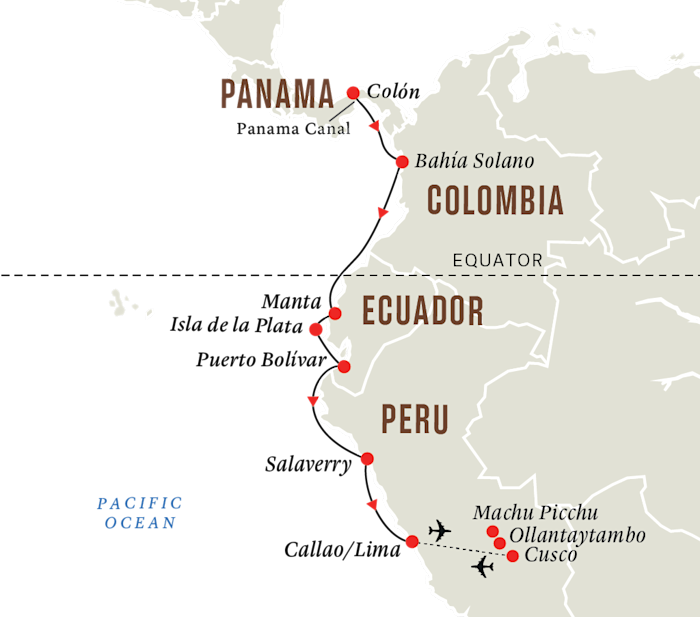
Board the expedition ship and enter the Panama Canal to experience one of man’s greatest feats of engineering. Then venture deep into the jungle of Darién National Park to meet the Emberá people, and head south to visit charming communities along the Pacific Coast. Explore Incan and Colonial sites in the Sacred Valley, including magnificent Machu Picchu.
Canal Transit and National Parks
Set off on your expedition cruise in Colón as you sail into the Panama Canal’s ingenious lock system. Once we’re through the canal, we’ll head to Darién National Park, where you’ll travel up river through the jungle to visit the indigenous Emberá community. Tour the Afro-Colombian community in Bahía Solano, before continuing to Montecristi (via Manta), the true home of the Panama hat. Then visit Isla de la Plata, home to Ecuador’s only coastal national park, Parque Nacional Machalilla, filled with the squawks of brimming birdlife.
Archeological highlights
At the port in Puerto Bolivar, visit a banana plantation or see exotic wildlife in Buenaventura Nature Reserve on optional excursions. Challenging currents could make landing at Salaverry impossible. If we do go ashore, however, you may visit the ruins of Chan Chan city or the Mochican temple pyramids on optional excursions, You’ll disembark in Lima and fly to Cusco in the Sacred Valley. There, you’ll explore the remains of Incan fortresses, a Colonial cathedral and convent, and the mysteries of Machu Picchu.
Key Expedition Details
Itinerary
Your adventure at a glance. Daily highlights, included activities, and optional extras to make it unforgettable.
The city of Colón lies by the entrance to the Panama Canal on the Atlantic coast. Here, you you’ll find high-quality hotels, hot springs, a thriving handicraft scene, and great restaurants featuring local delicacies.
Once you board the ship, pick up your complimentary expedition jacket, explore the ship, and then attend a mandatory safety drill. After dinner, you’ll meet your Expedition Team, who will run through some important primers with you.
Pre-Program
If you want to really explore the city or join a Pre-Program where you’ll spend time in a beautiful jungle lodge next to the Chagres River, you should arrive a couple of days earlier.

We depart Colón early in the morning to start the process entering the Panama Canal. The complex canal network is over a hundred years old, stretching almost 50 miles through natural and man-made waterways. We’ll wait eagerly for our allocated slot to enter the first of a series of huge locks. In a feat of modern engineering, these ingenious locks effectively lift the ship more than 80 feet above sea level. If weather allows, the Expedition Team will be on deck to point out sites of interest around the canal and talk about the history of this ambitious project.
Roughly halfway through the 12-hour transit of the canal, the ship will enter the Gatun Lake section. Created after the nearby Chagres River was damned, it’s one of the largest artificial lakes in the world. In contrast, the surrounding rainforest is virtually untouched by any development. The flora and fauna native to Central America flourish here, undisturbed. If you’re lucky, you may spot a crocodile or alligator ashore. Watch the trees and you may also catch a glimpse of a monkey (and maybe even a sloth or two).
After a few more locks and lakes, the ship will pass under the Bridge of the Americas and emerge in the Pacific Ocean. In one day, you’ll have experienced the culmination of centuries of planning, hard work, and resourcefulness, and cross from one great ocean to another in the process. It’s sure to be an experience you won’t forget.

The little town of Bahía Solano is the largest settlement on Colombia’s Chocó coast, near the mouth of Rio Jella and surrounded by thick jungle. It is also called ‘Ciudad Mutis’, after the 18th-century Spanish botanist José Celestino Mutis. Such a name could be an homage to the natural biodiversity that exists in the area’s jungles, mangroves, mountains, marshes, rivers, and bays.
The community here will open their town to us, as they warmly invite you on a guided walk through their settlement. Meet and talk along the way to the Afro-Colombian residents who live alongside the indigenous Emberá people, and other Colombians from the interior. Passing by the main church and kindergarten, we’ll come to the local secondary school, where students will greet you with a traditional welcome song and show you around their classrooms. At the small fishing port, learn about the town’s fishing co-op, the main source of income for the community. Your tour ends at the seafront, where you’re in for a treat: a performance of unique Afro-Colombian music and dance.
You may also join an optional excursion to the botanical gardens located on the long sandy beach of Playa Mecana. The botanical gardens are actually a 170-acre jungle reserve with fascinating nature trails, and home to a seed bank and different reforestation projects. Other possible optional excursions will take you to the fishing village at Playa Huina, where you’ll have the opportunity to walk through the jungle to waterfalls with crystal-clear swimming holes, or to visit a local indigenous community.


Spend some of your day at sea taking a relaxing walk out on deck. Enjoy the seascapes and keep an eye out for marine life such as whales, dolphins, and seabirds. Head to the Science Center and make the most of the Expedition Team’s lectures to learn about what you will experience in the following days. Participate in a Citizen Science project, where you will help contribute to current scientific research being conducted around the world. When darkness falls and it’s a starry night, you can also join the Expedition Team on deck for some stargazing. Or settle into a seat in the Explorer Lounge & Bar to raise a glass or two with your new-found friends.

We cross the Equator early in the morning. In a traditional ceremony, we’ll seek King Neptune’s blessing on board. If luck is on our side, he might even make an appearance before we reach our first call in Ecuador.
The main attraction of the day will be to Montecristi, located 5 miles inland from the tuna-fishing port city of Manta. The town was established in the 16th century by manteños fleeing the frequent pirate raids on the coast. Even though it is located in Ecuador, Montecristi is the actual birthplace of the Panama hat, despite its name. The misnomer originated when President Roosevelt wore one of these hats on a visit to the Panama Canal in 1904, sparking their popularity worldwide. There are plenty of shops selling the genuine article, which local artisans have expertly handwoven from the leaves of the jipijapa tree.
When you’re done hat-hunting, browse the stalls at the town’s pretty plaza, admire the architecture of the church, and look at the varied street art. One prominent mural at the plaza depicts General Eloy Alfaro, two-time Ecuadorian President and a Montecristi native. If time allows, head to the top of the main hill, where there is a museum and a grandiose mausoleum in honor of Alfaro, who was also known as the Viejo Luchador (Old Warrior).

Isla de la Plata is a part of Parque National Machalilla, Ecuador’s only coastal national park. The island sits a ways off the coast and is prone to large waves that can make landings a challenge. Its nickname of ‘Silver Island’ is thought to come from the belief that English seaman Francis Drake buried a treasure trove of silver here. This nickname could also come from the copious bird guano reflected in the sunshine, giving the island a shiny, silvery look when seen from the mainland. Unfortunately, no treasure has ever been found on the island, which is just over two square miles in size.
But what the island lacks in size or silver, it more than makes up for in the wide range of wildlife, even rivaling that of the Galápagos Islands. If we are able to land here successfully, keen birdwatchers take note! Have your binoculars at the ready to spot some of the 32 species of birds found here, including the famous blue-footed boobies, nesting waved albatross, pelicans, gannets, and frigate birds. The wildlife in the island’s waters are equally diverse. Keep an eye out for whales, manta rays, green turtles, and dolphins.

Machala’s main claim to fame is Puerto Bolivar, an important Ecuadorian port where coffee, cocoa, shrimp, and bountiful bananas (which the locals call oro verde, or ‘green gold’) leave for export. As part of one of our optional excursions, you may have the opportunity to visit a local banana plantation, or to try and spot hummingbirds, parakeets, and howler monkeys in the Buenaventura Nature Reserve to the south. The nearby Puyango Petrified Forest has one of the largest collections of fossilized trees in the world, thought to be about 100 million years old—as old as the Andes Mountains themselves.
Feast on fresh seafood at Puerto Bolivar at one of the harbor’s many restaurants, and enjoy views of the natural mangrove swamps of Isla Jambeli. Machala has all the charm you’d expect from a small coastal city. Stroll through quaint plazas filled with friendly locals, and admire unusual monuments dedicated to sorting fish and bananeros. The restaurants here are evolving and have started dabbling in the hip, modern cuisine for which Ecuador and Peru have increasingly become known.

Enjoy another day at your leisure aboard the ship. Continue to take advantage of the many onboard facilities and join in on lectures (perhaps on Peruvian culture and history) as we prepare you for the final days ahead. You can also spend some time on deck sunbathing, or slip into your bathing suit and enjoy one of the outdoor hot tubs. Or, bask in a state of zen during a guided meditation class. And if the warm weather hasn’t opened up your pores, a session in the sauna is sure to do the trick. Had enough of the sun for the day? Head inside to join an art workshop, or maybe swap stories about the cruise with your shipmates in the Explorer Lounge & Bar.

Pummeled by the Pacific’s wind and waves, Salaverry can be a hard port to access. If we are able to land there, though, it’ll be a good starting point to explore Trujillo, Peru’s third-largest city, and the array of archeological sites scattered throughout the region.
Trujillo sits in a fertile valley oasis irrigated by the Moche River. It boasts a colorful Baroque 17th-century cathedral, 10 colonial churches, and many Neoclassical mansions, not to mention one of the longest mosaic murals in the world at the local university. It’s more likely, however, that your focus will be further back on the past.
The city of Chan Chan was created by the Chimú Empire, which appeared in the region around 900 A.D. The vast ruins of the complex, measuring almost 8 square miles, include the Tschudi temple-citadel and Huaca Esmeralda. On the other side of Trujillo are you’ll find the Mochican pyramids of the Sun and the Moon. These pre-date Chan Chan by a few hundred years! Huaca del Sol stands out as the largest adobe structure on the continent, while Huaca del Luna is a more detailed specimen, with many of its pastel frescos still visible.

We arrive in Callao at noon, where you’ll bid a fond farewell to the captain and the crew. A packed lunch will be provided for your transfer to the Lima airport and your flight to Cusco. Once we arrive in the former capital of the Incan Empire, perched over 11,000 above sea level, we’ll head to the Tambo del Inka Resort in the Sacred Valley for dinner and a good night’s sleep.

Eat a good breakfast at the resort, because you’re in for an unforgettable day. We start off in Ollantaytambo, once the royal estate of Pachacuti, the Incan emperor. He conquered the region and built up the town that shares its name, featuring a formidable stone fortress that still towers above the community on a massive cliff. Constructed with rose-colored granite, this huge structure was once a thriving complex of baths, temples, and military barracks. This fortification was the valley’s main defense against their rivals, the Antis people. It was also the site of the Inca’s greatest victory against the Spanish during the Spanish conquest of the Incan Empire, also known as the Conquest of Peru.
Then we head to the nearby train station and board the deluxe Hiram Bingham train to Machu Picchu. Enjoy a savory brunch while you marvel at the views on the way to this magical and renowned location.
At last, we arrive at the spectacular Machu Picchu. Built around 1450 and abandoned with Spanish colonization, thick tangles of vines and trees shielded it from the prying eyes of the outside world for centuries. After being ‘found’ by American archeologist Hiram Bingham in 1911, ‘The Lost City of the Incas’ is now widely regarded as one of the ancient wonders of the world.
Explore the city’s ruins and imagine what life was like here, when priests, craftsmen, and servants roamed these cliffs. Excavations at the site have revealed skeletons, artifacts, and woolen clothing. Now it’s your turn to admire the precise Incan stonework. Even if we have a basic understanding of the site, the Incas left no written records behind about the city’s rise or fall. Thus, Machu Picchu remains one of the most mysterious archeological sites in the world.
After spending an eventful day at these two sites, we’ll return to the Tambo del Inka Resort by train for a relaxing evening and an overnight stay.

After breakfast, we’ll head back to Cusco to visit the Sacsayhuamán fortress. It’s strategically located on a hill overlooking Cusco. Like many other Incan structures, it was constructed without mortar. The enormous stones can weigh up to 200 tons a piece but still fit together so tightly that not even a thin blade of grass can slide between them. This is a lasting testament to the Inca’s sophisticated construction techniques and architectural skills.
Next, we’ll explore the splendid Baroque-style Cusco Cathedral, built by the Spaniards in the mid-1500s on the foundation of an Incan palace. Many of the stones used to construct it were looted from the nearby Sacsayhuamán fortress. Then we’ll visit Koricancha, where we’ll admire the Dominican Convent of Santo Domingo, built on the foundation of the Temple of the Sun, the most important temple in the Incan Empire. The curved masonry wall at the west end of the church, built without mortar, is considered to be one of the greatest existing examples of Incan stonework.
At lunchtime, we’ll eat at a local restaurant before our transfer to the airport for the flight to Lima. Upon arrival in Lima, you’ll meet our local guide and transfer to the hotel. Enjoy the evening at your leisure in Peru’s capital after check-in,. We recommend heading to the bars and restaurants of the trendy Barranco neighborhood, or drop by the illuminated ruins of the ceremonial clay pyramids Huaca Pucllana and Huaca Huallamarca.

After breakfast at the hotel, you’ll say farewell to your fellow explorers. Seeing as you’re already here, we recommend extending your journey a few days to spend extra time in Lima, also known as ‘The City of Kings’.
The historic center, which is a UNESCO World Heritage Site, is full of Colonial-era architecture, such as the Plaza Mayor and San Francisco Monastery. In contrast, the clay ruins of the Huaca Pucllana and Huaca Huallamarca ceremonial pyramids are remnants of the long-lost Incan civilization.
There are at least four different museums you can explore for a deeper dive into pre-Columbian archeology. Art lovers will enjoy the bright and arty area of Barranco, complete with murals, creative cafés, and two of Lima’s contemporary art museums.
Many say the ultimate Lima experience revolves around the food. Cuisine from the capital has made a splash the world over. Try it in one of the many internationally recognized and award-winning restaurants found here.
One of Peru’s all-time gastronomic greats is ceviche, fresh fish marinated in tangy lime juice and other seasonings. You can savor this staple dish in many locations around the city, from up-market diners in Miraflores to basic cevicherías at the fishing docks over in Chorrillos.
As you reflect on your expedition cruise, you’ll no doubt already be planning your next one. We look forward to welcoming you on board for more adventures soon.

What else is included?
Our South America ship
Get a taste of what life is like on board the ships that sail on this itinerary