Expedition Travel Guide for the Galápagos Islands
Whether you're a nature enthusiast, adventure seeker, or curious traveller - start planning your journey and get ready to expect the unexpected as you experience the pristine beauty of these iconic islands.
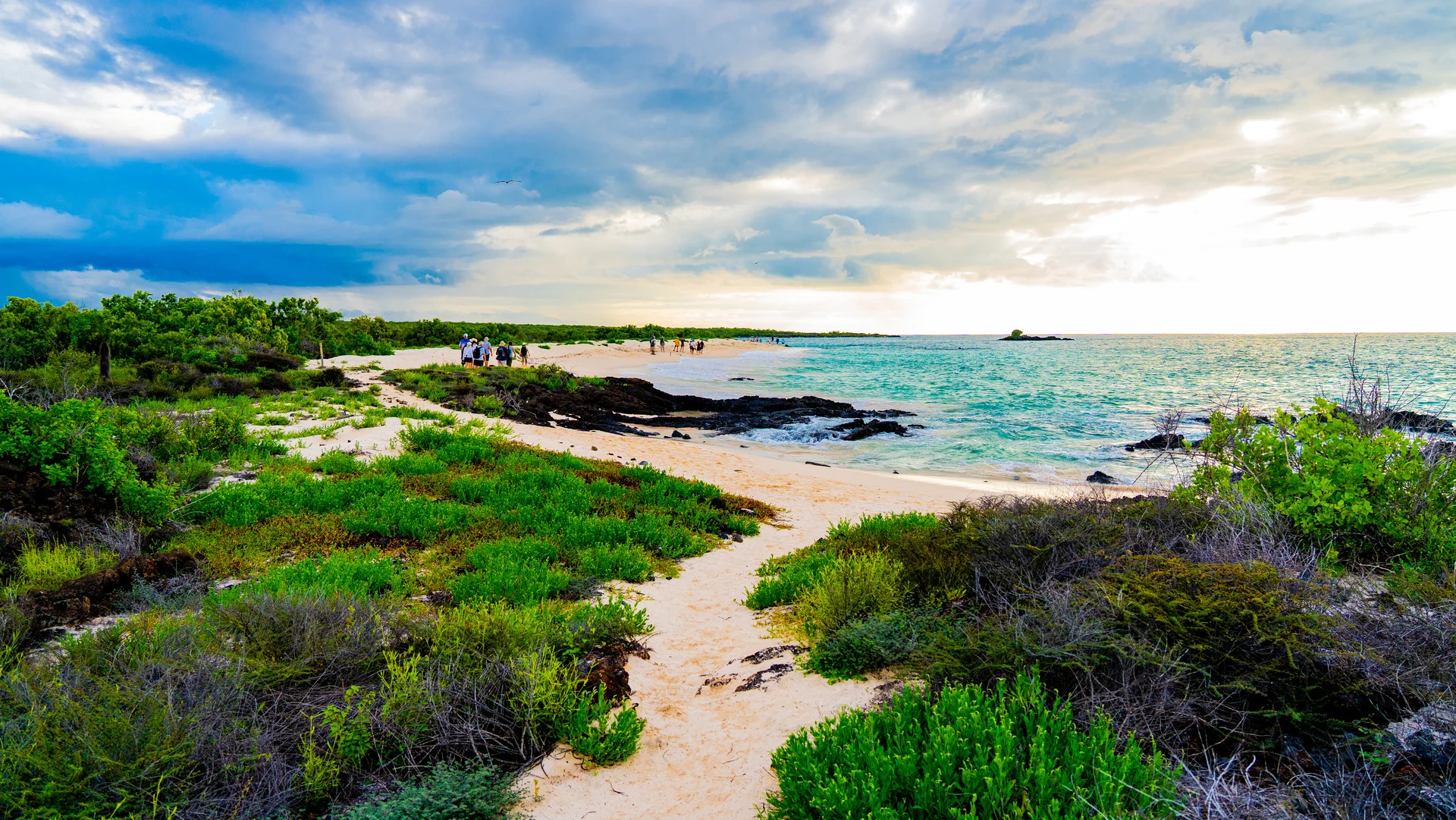
The Galápagos Islands | 'I never want to leave'
What if you could discover the unforgettable wonders of the Galápagos Islands, Earth's natural wonderland? With HX Expeditions, you can!
Exploring these idyllic islands onboard our small expedition ships will take you off the beaten track and closer to nature for a more intimate experience. Nestled off the coast of Ecuador, in the Pacific Ocean, this remote archipelago is a living laboratory of evolution, home to unique and diverse wildlife that have been inspiring explorers and naturalists ever since Charles Darwin first stepped foot here in 1835.
With our Travel Guide, we have all the essential travel tips, packing lists, and insights to get you ready for your Galápagos trip.
Experience a showcase of evolutionary biology
Formed by a series of volcanic eruptions several million years ago, these remote islands were seeded with life by animals drifting across the ocean from the rainforests of Central and South America. Arguably, no other place on Earth can compete in terms of unique wildlife experiences. Not only are there many endemic species here, but they have evolved without mammalian predators and are for the most part unafraid of humans.
It was the naturalist Charles Darwin who put these paradise isles on the map, visiting in 1835 and noting the differences between subspecies on the various islands. This led him to develop his theory of evolution driven by natural selection, outlined in his seminal book On the Origin of Species. Today, the Galápagos Islands are sometimes likened to an open-air laboratory, attracting evolutionary biologists and wildlife lovers alike.


Know Before You Go
Planning your trip to the Galápagos Islands shouldn't be daunting! To help, we have answered some of the most frequently asked questions to kick-start your planning.
What do I need to pack for the Galápagos Islands?
Regardless of what time of year you visit, a good pair of sturdy walking shoes (Day hikers) are recommended for the hikes as trails vary in difficulty, but most are of volcanic nature.
When is the best time to visit the Galápagos?
Being in the tropics, it’s always a good time to visit the Galápagos Islands, and there’s an array of extraordinary wildlife to discover all year round.
How do you get to the Galápagos Islands?
Two airports are best located for the Galápagos Islands and they are Quito’s Mariscal Sucre International Airport and Guayaquil's José Joaquín de Olmedo. Both are short domestic flights from the Galápagos Islands.
How will I explore the Galápagos Islands? What is a typical day like?
Expect the unexpected as you explore the Galápagos Islands by sea and land, with a range of daily excursions, science projects, and talks we will ensure you uncover the magic of these iconic islands.
Our small expedition boats allow us to land on beaches and terrain away from the crowds. Exploring the various islands on foot turns an adventure into an expedition - with hikes amongst the distinct ecosystems for a more intimate experience amongst the truly unique flora and fauna.
Or what could be better than drifting over a colourful reef and seeing marine life illuminated in crystal-clear water? Where the conditions allow, you can take to the water where you could snorkel amongst sea lions or even paddleboard past penguins. With MS Santa Cruz II as your floating base camp, it is the perfect spot to return to for some relaxation and reflection on some of the lifelong memories made in the Galápagos Islands.
A typical day in Galápagos

Wildlife watching
On your trip to Galápagos, the number one draw is watching the wildlife. There’s so much to see your head will be spinning, but your Expedition Team know all the best places to make your experience nothing short of extraordinary. You’ll join them on nature walks across wild islands where the trails are shared with land iguanas and lava lizards, and trek along volcanic beaches where Sally Lightfoot crabs scuttle over jagged black rocks and pelicans flap languidly overhead.
In small expedition boats we’ll head into hidden coves packed with sea lions and marine iguanas, and cruise close to rock stacks where birds such as Nazca Boobies, Galápagos Penguins and Swallow-tailed Gulls nest. In the waters around the boat petrels seem to walk on the sea while Blue-footed Boobies arrow themselves into waters with uncanny precision to catch fish.
Under the waves you’ll witness myriad tropical fish shimmering in the watery sunlight, and perhaps the sleek and streamlined shape of a reef or hammerhead shark casually swimming by. Here, curious sea lions move sinuously like acrobats, and turtles swim up for a closer look at you.
In Galápagos, you don’t just watch the wildlife, encounters can be so close you almost become a part of it. Rest assured, we always follow a strict code of conduct about maintaining the correct distance so that we do not disturb the inhabitants of these remote and unspoiled isles. We are, after all, guests in their home.
Take to the waters
The best way to explore the clear blue waters of Galápagos is to step off Santa Cruz II into one of our small expedition boats. These nimble vessels are designed for cruising around the archipelago without disturbing the wildlife, so they’re perfect for spotting land, shore and sea birds. There are over 50 species native to the islands, from Galápagos Penguins and the magnificent Galápagos Albatross – which only breeds on Española – to red-throated Frigate Birds and three species of boobies. We’ll also look out for the Swallow-Tailed Gull, nesting peacefully on cliff ledges as we sail by.
Our small expedition boats give us access to up to 13 of the islands, taking in a diverse range of habitats and ecosystems. This way, we can explore towering cacti and giant iguanas in rocky, arid landscapes one day, and revel in lush tropical highlands and white sandy shores the next.


Kayaking
For those who enjoy kayaking – or are trying it for the first time – the experience in Galápagos is unlike any other. Here you’ll skim across crystal-blue waters, taking your place in the realm of wildlife around you. Guided by your Expedition Team, you’ll head for areas across the archipelago where we can encounter animals and birds in close proximity.
From your vantage point close to the water, you may see whales and dolphins breaching in the distance, as well as sleepy sea lions basking in the sun and curious turtles bobbing their heads up to give you a closer look.
A deeper dive
A whole other world awaits beneath the surface of the sea. Once you’ve observed the variety of birds, reptiles and mammals above, snorkelling in the waters around the islands is a welcome chance to cool off and view marine life at its very best.
Here you’ll see or swim alongside brightly coloured fish, placid turtles and the world’s only marine iguanas – always keeping a respectful distance, of course – as well as inquisitive sea lions turning somersaults in the water. Three ocean currents meet at the Galápagos Islands, resulting in extensive marine biodiversity in this carefully protected area, along with many species that can only be observed right here. If getting wet isn’t your thing, Santa Cruz II has a glass-bottom boat which allows you to see all the marine life from the comfort of your – dry – seat.

Discover Wildlife only found in Galápagos

Galápagos’s most famous resident
It was the world-renowned Galápagos giant tortoise that gave the islands their name, and it continues to enchant nature lovers across the globe. Their leisurely existence – grazing, sunbathing and resting for 16 hours a day – belies a sad history of hunting, deforestation and near extinction. As a result, it’s a joy to watch them thrive in their natural habitat. Resourceful and adaptable, the Galápagos giant tortoise grows to up to six feet long and famously can live to be over a century old. As a protected species, its only predator is now the Galápagos Hawk, which preys solely on eggs and baby tortoises. Fortunately, the Charles Darwin Foundation – which you will visit on your expedition – is working hard to protect all 12 species on the islands through research and breeding programmes.
Colourful local characters
Notoriously lacking in caution but with plenty of charm, the Blue-footed Booby is a seabird largely associated with Galápagos. Its name originates from the Spanish word “bobo”, meaning foolish, and while their comical courtship dance and curiosity around humans may fit the bill, they are also extraordinarily graceful in flight, diving with pinpoint accuracy into schools of fish, and sometimes even catching them in mid-air. You may hear Blue-footed Boobies grunting and whistling to each other in conversation before you see them, perhaps warming their eggs with their bright blue feet or waddling closer to inspect you and your fellow expeditioners.

Legendary wildlife
The Galápagos archipelago is extraordinarily varied in terrain, featuring a range of habitats, from arid and dry to lush and green. As a result, bird and animal species have branched off into subspecies in order to adapt to natural conditions. The most well-known of these are the land and marine iguanas, the giant tortoises and the so-called Darwin’s Finches. These finches vary widely in size and beak formation, reflecting their adaptation to different habitats and food sources.
Galápagos Brown Pelican
The Christmas Iguana
Red-Footed Boobies
Galápagos Sea Lion
Great Frigatebird
Sally Lightfoot Crab
Lava Lizard
The Galápagos Penguin


A family adventure
Our Galápagos expeditions are perfect for families looking for an unforgettable experience to share. With safety and comfort always in mind, an HX Expeditions adventure in this iconic archipelago is family-friendly and ripe for memory-making as you discover the wonders of nature together with the people you love the most.
With their unique wildlife and captivating natural beauty, the Galápagos Islands offer something truly unique. Alongside activities such as snorkelling, paddleboarding and kayaking, you and your family will learning about evolution and diverse ecosystems, digging deeper into a wide range of subjects in the Science Centre, and simply having fun whilst doing so.
All kids love animals, so sharing close encounters with giant tortoises, playful sea lions and more is an engaging and enjoyable way for them to learn. Experience all the excitement of an HX Expeditions voyage together and cement treasured memories that will last a lifetime.


Adventure for all ages
Through cruising and curated excursions, your children can immerse themselves in a Galápagos adventure, authentic culture, unique wildlife, and dream-like landscapes, creating unforgettable memories and gaining a deeper appreciation for the wonders of Galápagos..
How can I get involved with the Science & Education program?
The Galápagos is at the center of many global conservation and research efforts, following the groundbreaking work of Charles Darwin in the early 1800's. You will have the opportunity to visit the Charles Darwin Research Station, where over 200 scientists and volunteers are engaged in numerous projects to boost biodiversity in the region.
The onboard Expedition Team and Scientists have many years of experience exploring and studying around the Galápagos Islands. Throughout your stay, they will deliver a range of in-depth lectures, ranging from the history of these islands, the unique biodiversity, and current conservation efforts. Where conditions allow we will also use the smaller expedition boats to undertake Citizen Science projects and use the onboard Science Center to analyse samples to aid international research across a range of areas.
An Expedition Team like no other
Lead by experts
Your friendly and knowledgeable Expedition Team is comprised of local Galápagos experts. They come with extensive experience, sharing their love of their home islands with travellers from all over the world, always delighted to experience the wonder of discovery with you. They’re walking treasure troves of fascinating facts and local stories, with a passion for travel, a love of our planet and a desire to share their knowledge.
Your team will be your guides as you explore this world-renowned ecological hotspot, leading you on shore landings and nature walks across the islands and bringing you to the best places to observe the wildlife. As experts in the islands and their conservation, they’ll explain the efforts that are being made to preserve this precious place. Expedition groups are small, with a maximum of 11 guests per guide, allowing them to tailor your experience to you and offer as much information, assistance and genial company as you’d like.


How do I find the right voyage?
Our onboard Expedition Team are your guides to the Galápagos Islands, sharing their knowledge and passion with our guests on everything from local customs and history to the local wildlife and ornithology. They are experts in the destinations we explore, and being onboard the ships are best placed to share their insight & recommendations on the different voyages we have on offer.
Best All Round
Nine of the Best Isles (Western & Northern Route) | 11 Days
Truly follow in the footsteps of Charles Darwin, on this journey of discovery. Visit nine of the most alluring islands on this adventure starting in Quito. See unique wildlife from giant tortoises to marine iguanas as you spend nine days in the Galápagos, exploring the islands of Baltra, Santa Cruz, Isabela, Fernandina, Floreana, Santiago, Rábida, Bartolomé and Genovesa.
Best Short Trip
In Darwin's Footsteps (Eastern Route) | 9 Days
Limited on time? This is the perfect itinerary covering some of the must-see sights. Embark on a journey of ecological discovery as we travel in Charles Darwin’s footsteps. You’ll spend two nights in Quito, one of South America’s most charming cities, before beginning a sevenday Galápagos expedition cruise taking in the islands of San Cristóbal, Sante Fe, Santa Cruz and Española.
Best for Culture
Nine of the Best Isles Plus Machu Picchu | 15 Days
Our ultimate Galápagos adventure. Visit Quito, Peru’s Cusco and Machu Picchu, and nine diverse islands on this 15-day land and sea combo. You’ll travel to the ancient heart of the Inca empire, before spending nine unforgettable days cruising the western and northern islands of Baltra, Santa Cruz, Isabela, Fernandina, Floreana, Santiago, Rábida, Bartolomé and Genovesa.

When is the best time to visit the Galápagos Islands?
Being in the tropics, it’s always a good time to visit the Galápagos Islands, and there’s an array of extraordinary wildlife to discover all year round.
The temperature doesn't vary significantly throughout the year - January to May are the warmer months but also the rainy season. It's during this time that the sea is at its warmest making it the ideal time to get into the water and spot some of the unique marine life. It's the main breeding season for many birds, reptiles, and land animals including the iconic Galápagos giant tortoise.
Between June - December, it is drier but has marginally cooler temperatures. The seas around the islands can be rougher due to cooling sea temperatures and the beginning of the garúa, or sea mist season. However during this time, it is the ideal time to see whales, dolphins, and penguins, who will be feasting on the bounty of the seas around the islands.
Whatever time of year you choose to explore these iconic islands - you will be sure of a unique adventure.


How do you get to the Galápagos Islands?
It may seem like getting to these remote islands is an expedition in itself however, many carriers fly to Mariscal Sucre International Airport (UIO) in Quito or José Joaquín de Olmedo International Airport (GYE) in Guayaquil.
Within the cost of your voyage, we include return flights in economy class between key gateways, and entirely dependent upon the expedition you choose. Be sure to check the 'What's Included' section of the voyage to see which applies to you, flights include:
from/to Quito or Guayaquil to Baltra and the Galápagos Islands.
from/to Lima - Cusco (Peru) for those with the Machu Picchu combination.
Please Note: The checked baggage allowance is up to 23kg, and a cabin bag of up to 8 kg. These limits can vary between long-haul and the included short-haul flights run by LATAM, to/from Lima (for the Machu Picchu programme) and Quito/Guayaquil (for Galápagos Islands). Additional luggage can only be booked as a paid service at the check-in counter.

What to pack for an expedition to Galápagos Islands?

The Galápagos offers a plethora of adventures as you experience the rich nature and unique wildlife of these idyllic islands. Regardless of what time of year you visit, a pair of sturdy walking shoes is recommended for the hikes as trails vary in difficulty, but most are of volcanic nature.
For those travelling in the warm season (January - May), we recommend focusing on shorts and loosely-fitting tops. This time of year is also the wettest, so be sure to pack a light rain jacket or poncho. If you are visiting during the cooler months (June - December), we suggest packing a light jumper or windbreaker for those chilly nights onboard.
We also recommend packing the following:
Insect repellent
Polarised sunglasses and sunscreen
Sandals or shoes you don‘t mind getting wet
Wide-brimmed sun hat with a chin strap
Swimsuit for the hot tubs
A pair of casual shoes for onboard use
Waterproof small back pack or bag
Rain Jacket
Prescription Snorkeling Masks
Don't forget you will also receive a complimentary reusable waterproof bottle, which is yours to keep at the end of the voyage.


Get to know the Islands
Renowned for their exceptional biodiversity, the Galapagos Islands are home to a wide range of plant and animal species found nowhere else on Earth. As you explore these volcanic islands you can meet the iconic Galapagos Giant Tortoises, marine iguanas, blue-footed boobies, and other endemic species.
Learn more about these unique islands, below.


Fernandina Island
One of the youngest of the isles, Fernandina is rocky, arid and covered in cacti. It’s one of the few places you can see the Flightless Cormorant and Galápagos Penguin.

Española Island
A wildlife haven with Blue-footed Boobies, Nazca Boobies and Galápagos Albatross, as well as marine iguanas and a famous blowhole.

Isabela Island
The largest of the islands is also one of the most volcanically active and is comprised of six shield volcanoes. Isabela is rich in birdlife and is also home to Galápagos giant tortoises.


