Svalbard Expedition – FAQs
Your questions about the Svalbard expedition answered — from what to pack and included nature landings to wildlife spotting, sea kayaking and exploring one of the Arctic's most spectacular wildernesses
1 mins read
Please note that while we strive to ensure this information is accurate and up to date, some details may change over time or vary depending on your specific voyage. This information is for Svalbard; however, there may be nuances per itinerary. Entry requirements, visas, health documentation, and personal travel responsibilities are always the responsibility of each guest to verify and complete. We strongly recommend checking official government websites, your personalised HX travel documents, and any pre‑departure updates provided by HX for the most current guidance before travelling.
HX Pre-Departure Expedition Checklist

Ready for your expedition?
Every great expedition starts long before you step onboard. Our Pre-Departure Checklist has been designed to help you prepare with confidence, bringing together essential information, practical guidance, and helpful reminders ahead of your voyage. Download your copy below and start getting ready for the adventure that awaits.
Clothing & Equipment
What clothing is provided, and what should I bring?
You'll receive a HX expedition jacket on board, which is windproof and water-resistant. We recommend packing layers underneath — thin wool or bamboo base layers work well in Svalbard's variable conditions. Waterproof trousers are essential for shore landings; without them, you may not be allowed on an expedition boat. A warm mid-layer and a down jacket are both worth packing, depending on your personal warmth preference.
Will we receive a jacket on board?
Yes. All guests travelling to Svalbard will receive a HX blue expedition jacket on board. Made from recycled materials, it is wind and water-resistant and available in sizes XS to XXXL. If you already have a jacket from a previous HX or Hurtigruten voyage, you are welcome to bring it and not receive a new jacket - and we can offer onboard credit instead. Please note, the jacket is designed as a shell so, we recommend packing layers to wear underneath your HX jacket.
Do I need waterproof trousers?
Yes. Waterproof trousers are essential for zodiac crossings and shore landings - without them, you may not be permitted on a Zodiac. Ski trousers that are waterproof are perfectly suitable.
What kind of footwear do I need?
Rubber expedition boots are mandatory for all shore landings in Svalbard, as all landings are wet. We loan them to you on board at no charge. Boots are available in sizes 35–50 EU and we also carry children's sizes. You collect them on board and can swap sizes if the initial pair does not fit. If your voyage includes Iceland stops, you may bring your own walking boots for those landings — the rubber boots are issued for the Svalbard section only. If applicable, bring walking boots for any pre/post programmes.
Do I need to bring my own hiking boots?
Not for the Svalbard portion of your voyage. The loaned rubber boots are sufficient for all shore landings. If your itinerary includes stops in Iceland, Germany, Norway or an overnight in Longyearbyen - you will want your own walking or hiking boots for those sections.
Are spiked shoes or crampons required?
No. The expedition boots provided on board are fully sufficient for Svalbard shore excursions. Spiked footwear is not needed.
What should I wear inside the expedition boats?
Wear thick, warm socks inside your rubber boots. The same layering approach applies on the water as on land — conditions can be cold and breezy on zodiac crossings regardless of the season.
What type of gloves are best?
Liner gloves paired with thicker, wind and waterproof outer gloves is the ideal combination. Average temperatures in Svalbard range from 3–6°C, and wind chill on the water can make cold hands uncomfortable quickly.
Do I need a hat?
Yes. A well-fitting hat - or one with a chin strap for windier conditions - is recommended. Svalbard in summer can also be surprisingly bright, so some guests prefer a hat with a peak for sun protection.
Do I need sunglasses?
Sunglasses are worth packing, particularly around the solstice when the midnight sun means extended exposure to bright light. They are not mandatory, but many guests are glad to have them.
Will we receive a packing list?
Yes. A detailed packing list is included in your travel documents, which are shared approximately one month before departure.
Can we bring walking poles?
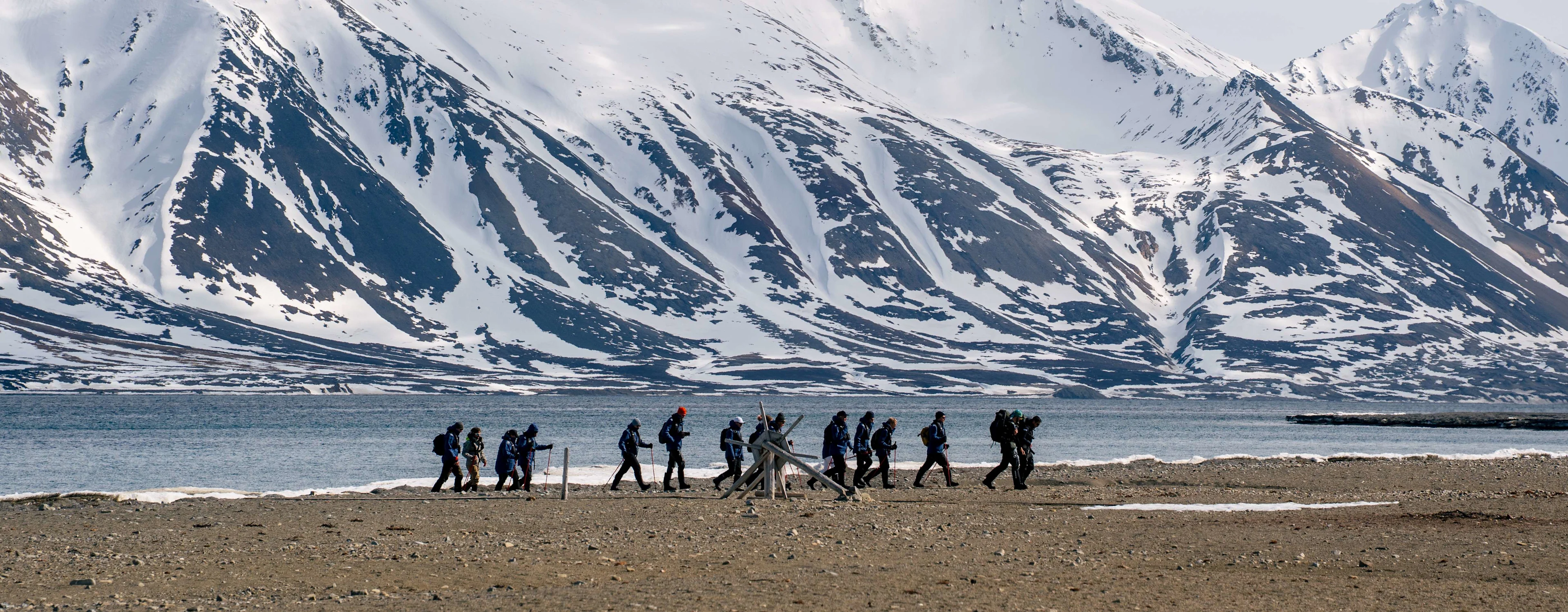
Yes. We also provide trekking poles for all guests on shore landings, and the expedition team will bring them ashore for you.
Will I need to submit my clothing size before the trip?
Yes. Before departure, you’ll receive a link to complete your Ship Manifest Information Form, which includes a section for clothing sizes and a sizing guide. This helps the crew prepare the correct gear for you. Sizes are only a guideline - if something doesn't fit, you can easily swap it out for a better fitting item once you get onboard.
Gear & Technology
Should I bring binoculars?
We have a limited number of binoculars available on board, but we recommend bringing your own to ensure you are not disappointed. For the best experience, choose binoculars with 8x or 10x magnification and an objective lens size of 32mm or 42mm. Please do not rely on onboard supply if you are an avid binocular user!
What camera setup do you recommend for Svalbard?
For wildlife photography, a 500 - 800mm lens will give you the reach you need for polar bears, walrus, and seabirds at distance. A versatile mid-range lens is equally worthwhile — some of the most extraordinary encounters in Svalbard happen at surprisingly close quarters. We recommend bringing a waterproof bag or dry bag to protect your equipment on zodiac crossings.
Can I bring cameras and bags on the expedition boats and shore excursions?
Yes. We recommend a waterproof rucksack or dry bag for your camera and equipment, as spray is possible on the water. A medium 15L dry bag is sufficient for most guests.
Are drones permitted?
Drone photography is not permitted during the expedition. If you are travelling onward after the voyage and wish to carry a drone in your luggage without flying it, that is fine — just ensure it remains packed and unused throughout.
Which Merlin Bird region should I download for offline use?
Download Europe: Scandinavia as your primary region. Atlantic Ocean is a useful addition for seabirds you may encounter on open water passages.
Activities & Excursions
What activities are included in the voyage?
All guests can enjoy a full programme of included activities - nature landings, expedition cruising, wildlife spotting, lectures, and workshops in the Science Centre. These are designed to deepen your experience of Svalbard without any additional sign-ups or costs.
Are there optional activities that come at an extra cost?
Yes. Sea kayaking is an optional activity available on both MS Fram and MS Spitsbergen, and this comes at an additional cost. All optional activities are bookable on board - there is no advance booking required before you depart.
Do I need kayaking experience?
No experience is needed. Our kayaking programme is designed to accommodate all levels. Before heading out, our guides run a full safety briefing and ensure you have the right equipment. Note that on MS Spitsbergen, sea kayaking is offered in double kayaks. Discovery Kayaking - an inflatable-style kayak option available on some other HX ships - is not available on MS Spitsbergen.
Can activities be booked before the voyage?
Activities are bookable on board once you have embarked. The Activity team will walk you through everything available and help you plan your programme for the voyage ahead. Additionally, if your itinerary includes stops in Iceland, Germany, or Norway - a selection of included and optional shore excursions can be pre-booked or booked on board.
Are there fitness or experience requirements for using the expedition boats?
Our expedition boats are designed for all guests. The main requirement is being able to get in and out of the boat comfortably and safely. Our expedition team is always on hand to assist.
What experiences are available independently in Longyearbyen?
If you are spending additional time in Longyearbyen, local operators offer a range of experiences not covered by the voyage itself - dog sledding (however, this may not be available at certain points in the season), visits to a coal mine, dedicated wildlife cruises, and guided tundra tours are among the most popular. All are subject to weather conditions and availability. We recommend exploring these after the voyage so there is no duplication.
Your Ship: MS Fram & MS Spitsbergen
What facilities are available on board?
Both ships feature an Explorer Lounge & Bar and a Science Centre, which hosts daily lectures, workshops, and expedition briefings. MS Fram also offers two restaurants (including the fine-dining Lindstrøm), an outdoor BBQ, gym, sauna, hot tubs, and a shop. MS Spitsbergen features Restaurant Aune (the main dining room with all meals included), Brygga Bistro - a casual venue serving snacks and light meals between restaurant hours - and a takeaway option for enjoying meals in your cabin.
What cabin options are available?
Both ships offer a range of cabins, from comfortable outside cabins to spacious Expedition Suites. Suites on both vessels include large windows, some with private balconies (some with hot tubs on MS Spitsbergen), premium bedding, and added comforts for scenic cruising. MS Fram also offers Grand Suites and select suites with twin-bed options, plus exclusive Lindstrøm dining access for suite guests. MS Spitsbergen suites include a Nespresso machine and binoculars for wildlife viewing.
What is included in the voyage price?
All HX cruises are all-inclusive and cover daily landings and excursions, all meals and drinks, gratuities, and access to Science Centre activities and lectures. Optional activities, such as kayaking, are available at an additional cost. If your itinerary includes stops in Iceland, Germany, or Norway, you can also enjoy a selection of included shore excursions, alongside optional tours available for an extra charge.
Are hairdryers available in the cabins?
Yes. Every cabin includes a hairdryer, so you don’t need to pack one.
Destination & Conditions
What kind of weather can we expect in Svalbard?
Svalbard's weather is generally Arctic - variable, dramatic, and worth preparing for. In early June, expect temperatures of 3–6°C, snow on the hills, and some on the ground. As June progresses, conditions warm gradually. In late July and into August, temperatures are milder but wind chill on the water can still be significant. Layers are essential at any point in the season.
Will there be ice on the voyage?
Yes. In the northern reaches of the archipelago, sea ice is a defining feature of the landscape and plays a central role in the wildlife we are there to see. Ice coverage varies year to year and month to month - your Expedition Team will navigate conditions accordingly and keep you informed throughout.
Are there polar bears on shore? Can we go and look for them?
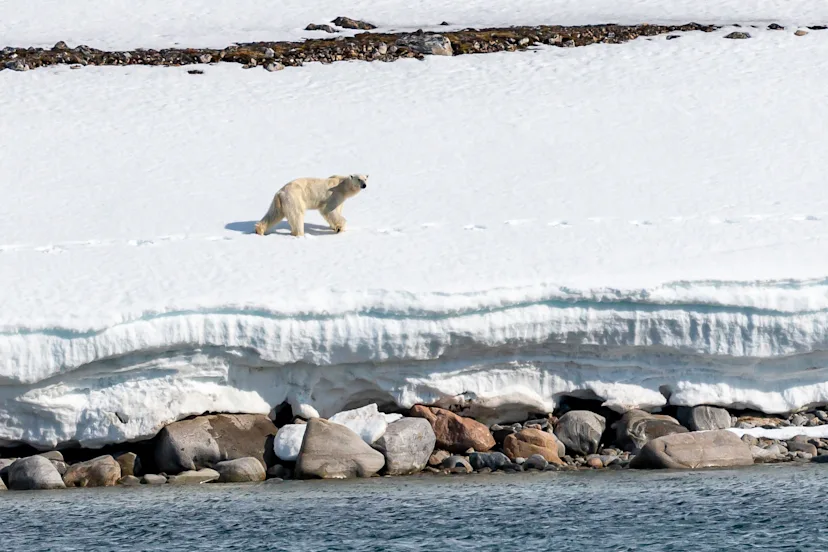
Polar bears range freely across Svalbard — this is their terrain, and every shore excursion is planned with that in mind. Our expedition staff carry rifles as a precaution whenever we go ashore, to abide with local legislation. There are no organised excursions specifically aimed at finding polar bears, but sightings are a genuine possibility on almost any day of your trip. Your guides will manage the group's safety and keep you as close to the wildlife as conditions and regulations safely allow.
How rough are the seas likely to be?
Sea conditions in Arctic waters can be demanding, and Svalbard is no exception. Conditions vary by route and season. Our ships are purpose-built for polar waters, and our experienced crews are well practised in managing passages safely. If you are concerned about seasickness, we recommend speaking to your doctor before departure and bringing sea-sickness medication for your journey.
Entry Requirements & Travel Documents
What do UK passport holders need to enter Norway and Svalbard?
You need a valid UK passport issued within the last ten years, with at least six months' validity remaining after your return date. No visa is required for UK passport holders. Please ensure your passport meets these requirements well in advance of travel.
Do German citizens need a UK ETA when transiting via a UK airport?
Yes. German and EU citizens - as well as travellers from Switzerland, Norway, Iceland, and Liechtenstein (except Irish citizens) - are required to hold a UK Electronic Travel Authorisation (ETA) when transiting through any UK airport, including Glasgow. We always recommend checking your government's official travel advice, as entry requirements may change, and it is the guest’s responsibility to ensure they have the correct documentation for their journey.
Is a visa required for the Hamburg to Svalbard voyage?
As a German citizen, no visa is required to enter Svalbard regardless of your route. However, Svalbard sits outside the Schengen Area, so you must travel on a valid passport. Visa and passport compliance is each guest's responsibility — please verify current requirements with your government or relevant embassy before you travel.
When we connect through Oslo (Schengen), are we leaving the Schengen Area to fly to Longyearbyen?
Yes. Svalbard is not part of the Schengen Area. When transiting Oslo for Longyearbyen, follow the airport signage for your onward flight — this will guide you through the correct departure process.
When will we receive domestic flight details (Oslo–Longyearbyen)?
Flight details for the Oslo–Longyearbyen domestic sector are typically shared approximately two weeks before your departure date. If you have not received them within that window, please contact your booking agent or our team directly.
What if our flights are disrupted or cancelled?
We have a 24/7 emergency team available for situations like this. Their contact details are included in your travel documents. They can assist with rebooking and will work with you to resolve disruptions as quickly as possible. Regional emergency numbers:
Australia / UK: +44 204 586 7869
France: +33 1 84 88 02 21
Germany: +49 40 87405667
Norway: +47 37 71 54 61
Switzerland: +41 800 100 158
US & Canada: +1 866 312 6791
Toll Free (US): +1 833 367 5017
Embarkation & Getting There
Are transfers to and from the ship included?
Yes. All guests have at least one overnight stay in Longyearbyen before embarkation, and transfers from the hotel to the ship are included. Transfer departure from the hotel is typically at 16:30.
Guests who have booked an extended pre-departure programme (with an additional overnight stay) will also have transfers included as part of that package.
What are the embarkation arrangements for the Glasgow (Fairlie) departure?
Embarkation takes place at Fairlie Quay. There is one quay in Fairlie — you will not miss it. If you are making your own way there, we recommend taking the train to Largs Station, where a complimentary shuttle bus runs to the quay throughout the embarkation window. No booking is needed for the shuttle. If you prefer a transfer from Glasgow Airport, this can be arranged at an additional cost — meeting point is at the airport at 12:30 for a 13:00 departure.
Will the ship be at a pier or will we board by expedition boat?
This depends on conditions and port availability on the day. The ship may be alongside the pier or at anchor. If at anchor, you will board using our Zodiac boats. Your crew will guide you through the process clearly and safely.
Are the Iceland port stops at a pier or via expedition boat?
For voyages on MS Spitsbergen, the three planned Iceland stops are at a pier. However, in true expedition style, plans can always change.
What happens with our luggage on embarkation day in Longyearbyen?
Your main luggage and any bulky bags will be transferred directly to the ship on the morning of embarkation. We recommend keeping only a light day bag with you during the pre-boarding hours in Longyearbyen.
Onboard Life
Is a professional photographer part of the expedition team?
Yes. A professional photographer travels with us as part of every expedition team, leads photography workshops on board, and captures the voyage itself.
Will we receive photos from the voyage?
Yes. Approximately two weeks after your voyage, you will receive your HX Logbook. This includes downloadable photographs from the onboard photographer, a map of your route, the expedition's Science and Education report, and a full record of wildlife encountered during the voyage.
What currency is used on board, and is cash needed in Longyearbyen?
The onboard currency is the Euro. In Longyearbyen, credit and debit cards are widely accepted — cash is rarely needed ashore and in many cases, no longer accepted. GBP is not accepted directly on board; most guests link a credit or debit card to their onboard account for purchases in the shop or bar.
Can dietary requirements be accommodated?
Our onboard teams are experienced in accommodating a wide range of dietary requirements. If possible, please let us know prior to boarding/during your booking stages. If you are spending time ashore in Longyearbyen, let the team on board know in advance and they will guide you on what is available locally.
Can children come on the expedition?
Yes. Expedition jackets are available from size XXS and rubber boots from size 32. The minimum age for sea kayaking is five years old, though the Activity Guide on board will make a final assessment based on whether your child can safely wear the equipment and follow the briefing. We recommend discussing this with the team when you embark.